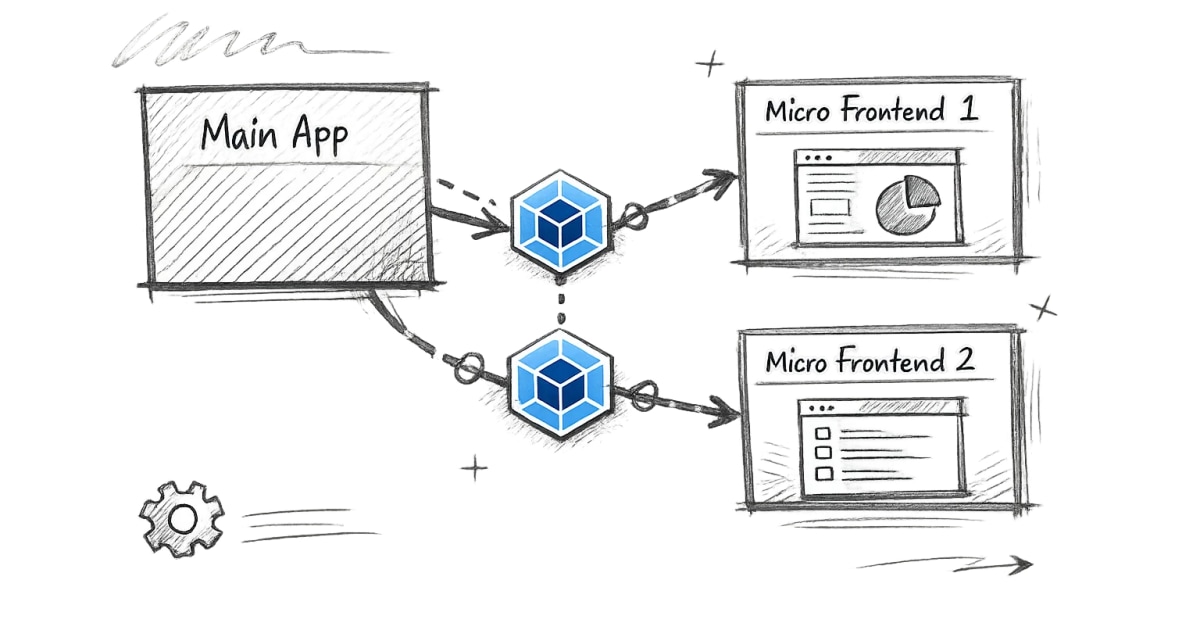

Micro-frontends are one of those ideas that sound better in a slide deck than they often feel in production.
That does not mean they are a bad idea. It means they solve a specific problem, and teams get into trouble when they adopt them for the wrong reasons. Angular’s own recent guidance is surprisingly balanced here: micro-frontends can increase team autonomy and independent delivery, but they also introduce real integration and runtime complexity. Angular does not officially support micro-frontends as a framework feature and recommends checking whether simpler alternatives, such as a monorepo with libraries, are enough first.
The problem micro-frontends actually solve
Micro-frontends are mainly an organizational scaling tool.
They start making sense when several teams need to work on different verticals with minimal coordination, separate release cycles, and stronger ownership boundaries. The Angular team’s own micro-frontend article says the main reason they have seen them adopted in practice is increased team autonomy, especially in large corporate environments where waiting on other teams becomes a real delivery bottleneck. It also notes that micro-frontends go beyond folder structure or libraries by turning each vertical into a separate application.
That is the first filter: if your pain is not cross-team coordination, independent deployment, or ownership at scale, you probably do not need micro-frontends.
What they cost
This is the part people skip too quickly.
Once you split a frontend into separate applications, you move from compile-time integration toward runtime integration. Angular’s article is very direct about the downside: it becomes harder to foresee problems before runtime, boundaries are harder to define cleanly, UI and UX can drift, and loading multiple applications can increase bundle downloads and memory pressure. It also points out that Angular, like other modern SPA frameworks, is optimized around compile-time checks and build tooling, so micro-frontend setups can undermine some of those advantages.
In plain English: you buy team autonomy by paying in complexity.
And that complexity is not only technical. It shows up in release coordination, shared dependency strategy, observability, testing, design consistency, and incident handling.
Good-fit scenarios
I think micro-frontends are a good fit in Angular when most of these are true:
- multiple cross-functional teams own clearly separate business verticals
- those teams need to release independently
- the boundaries are stable enough to become separate applications
- the business is large enough that coordination cost is already hurting delivery
That lines up closely with Angular’s own framing: enterprise systems often have several teams, and micro-frontends are attractive when low-coupled verticals map well to those teams and reduce the need for coordination. The same article also mentions build-time benefits from smaller applications combined with incremental builds, though it points out that you can get some of those benefits without going all the way to micro-frontends.
That last point matters. Sometimes teams reach for micro-frontends when what they really need is a better monorepo structure, clearer ownership, and proper library boundaries.
Bad-fit scenarios
I would avoid micro-frontends in Angular when the core problem is still inside one team, one product, or one release train.
They are usually a poor fit when:
- one team owns most of the frontend anyway
- domains are tightly coupled and change together
- UX consistency is critical and hard to manage
- the application already struggles with performance
- the platform team is too small to support the extra operational load
- the motivation is mainly “future-proofing” or novelty hype
Angular’s own guidance essentially says the same thing in a more careful way: before going this route, evaluate whether alternatives like a monorepo and libraries are sufficient. Angular’s docs also describe workspaces with multiple projects and shareable libraries as a good fit for advanced users and enterprise monorepo development, which is often the more boring and better answer.
The integration styles that matter
Not all micro-frontends are the same.
At the safer end, you have route-level composition, where separate applications own separate areas and integrate at coarse boundaries. That is usually the cleanest version.
At the riskier end, you have fine-grained runtime composition, where remotes share dependencies, render inside each other, and behave more like one distributed UI runtime. Module Federation and Native Federation exist to support that style by letting multiple projects share code and load modular pieces independently. Their own docs describe decentralized code sharing and independently developed, tested, and deployed modules as the core model.
From my opinion, the finer the runtime composition, the more careful you need to be. If you can keep the boundaries large and obvious, you reduce a lot of pain.
Operational concerns most teams underestimate
This is where real projects either become solid or messy.
If you choose micro-frontends, you also need answers for:
- shared dependency versioning
- authentication and session handling
- design-system consistency
- monitoring across app boundaries
- local development across teams
- integration testing across separately deployed parts
- SSR and hydration strategy, if you use server rendering
This part is getting more important, not less. Angular supports SSR and hydration in mainstream application setups, and hydration is specifically tied to SSR apps and measurable performance metrics like LCP and CLS. If you decompose an Angular frontend across independently delivered applications, you need to decide early how rendering and hydration work across those boundaries instead of treating it as a later detail.
Module Federation’s current ecosystem also reaches into Node.js and SSR scenarios now, which makes more advanced server-side integration possible, but it also means the architecture surface is larger than it used to be.
The decision checklist I would actually use
Before recommending micro-frontends for an Angular system, I would ask:
- Is our main bottleneck team coordination, not just code quality?
- Do we have stable domain boundaries that could survive as separate applications?
- Do teams truly need independent deployments?
- Can we fund the platform work needed to keep UX, dependencies, and operations coherent?
- Would a monorepo with well-designed libraries solve most of the same pain for less cost?
If the answer to that last question is yes, I would start there. Angular’s own docs and guidance give you a strong workspace-and-library model for sharing code across multiple projects, and Angular’s micro-frontend guidance explicitly recommends evaluating that path before committing to runtime composition.
My practical recommendation
Micro-frontends make sense in Angular when the organization is already large enough that independent ownership and deployment matter more than the extra complexity they introduce.
They do not make sense just because the codebase is big.
That distinction is the important one. Large codebases can often be fixed with stronger domain boundaries, better library design, and clearer governance. Micro-frontends become interesting when those measures are no longer enough because the organization itself needs more separation.
The hard part is not implementing module federation. The hard part is deciding whether the business and team model actually justify it.